
Feb 13, 2026
Why Are Raffia Bags So Expensive
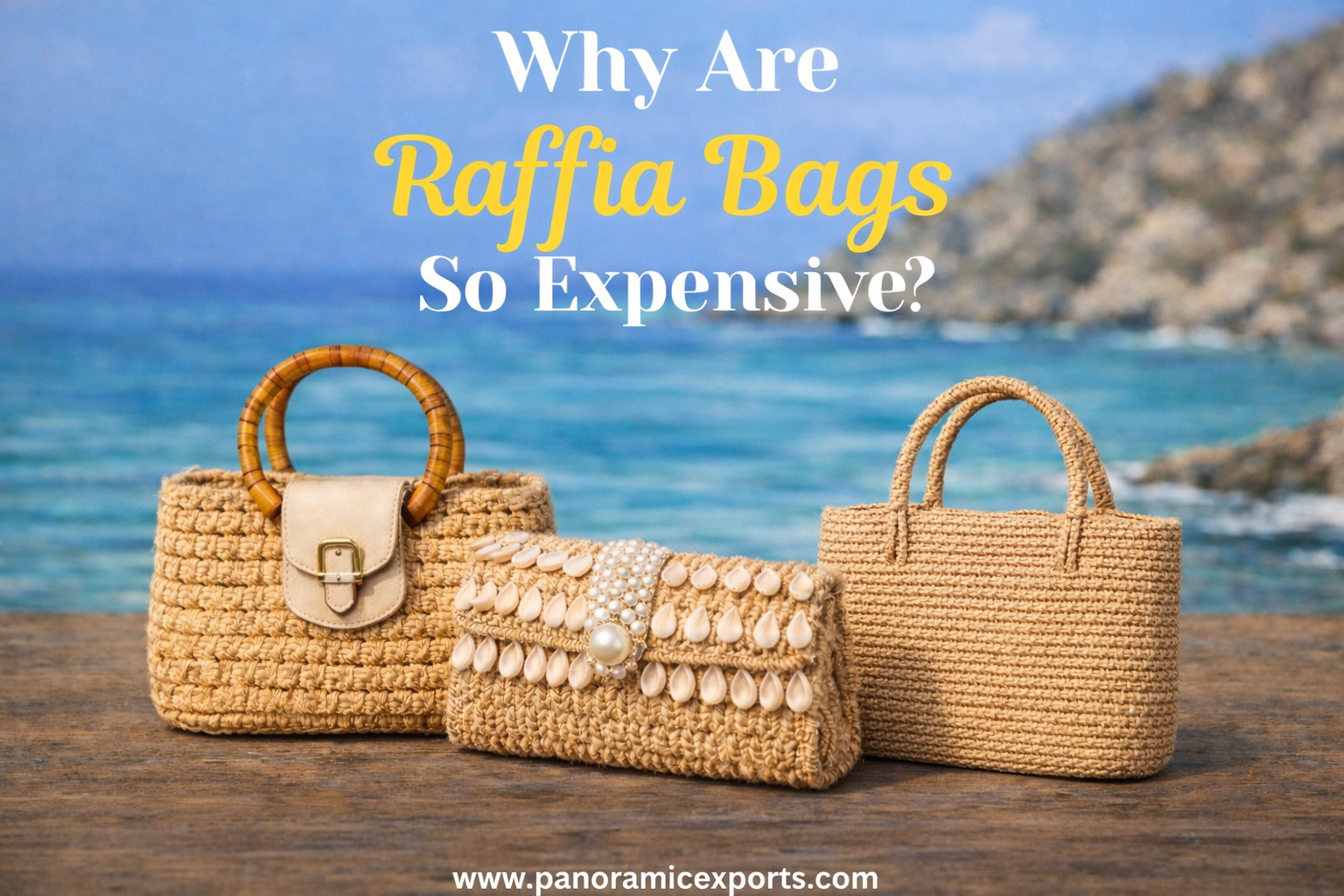
Why Are Raffia Bags So Expensive
Raffia bags are always made to be positioned as high-end accessories to buyers in the USA and the international market. Retail customers tend to compare them with the synthetic bags and ask about the difference in price. The fact is that these Bags are not the products of mass production made of plastic material, they are natural and hand-crafted goods that are formed by the material constraint and craftsman techniques and moral manufacturing mechanisms. The pricing is their whole chain of values, which puts more emphasis on sustainability and craftsmanship rather than speed and automation.
The wholesale purchasers who deal with Panoramic Exports enjoy the knowledge of these cost drivers. Explaining the pricing will make the raffia products easier to sell as high-end lifestyle products, and not as an overpriced substitute.
The Price of the Natural Raw Materials Used
Raffia Bag is made with the base of the fiber of the raffia palm leaf. Raffia has to be planted, harvested and processed manually as opposed to synthetic materials which are produced using petroleum. Farmers take the time to pick the fibers and dry them under controlled conditions and get ready to weave.
This agrarian dependency brings about uncertainty. The pricing of raw materials is directly influenced by the weather system, crop production and the cost of transporting the raw materials. Sustainable harvesting also curbs over harvesting which maintains long term supply without going to the extent of mass extraction which is cheap. The sourcing of natural fibers is more cumbersome and slow than synthetic because it is more labor intensive, and the structural distinction adds to the baseline price.
Raffia is a highly valued sustainable and biodegradable natural fiber used widely in eco-friendly fashion and handcrafted products such as bags, purses and accessories, making it a preferred choice for environmentally conscious buyers.
Raffia Bag and Artisan Handcraftsmanship
Human craftsmanship is the greatest price force behind a Raffia Bag. Majority of the bags are woven or crocheted or sewn in hand as opposed to being made using automated machine. Raised artsmen devote hours to the process of shaping, strengthening seams and cutting edges.
Unless the durability and aesthetic quality is compromised, handcrafted production cannot be speeded up. Both the works represent the skill of artisans who have undergone years of training. Differences in weave and texture are marks of genuineness and not flaws. The buyers are satisfying themselves with the skilled labor, cultural craft traditions, and human time, which possess an intrinsic value.
Ethical Production Economics and Raffia Bag
Ethical manufacturing is a direct factor that impacts the price of these Bags. Responsible production means that the artisans work in good conditions and under fair wages. Ethical workshops are run in controlled settings opposed to in-formal labor system.
Ethical sourcing is becoming more brand-identity related to USA and global buyers. The retailers have to be transparent in order to satisfy the consumer expectations. Production based on ethics balances supply chains, helps artisan communities and minimizes reputational risk. Although it makes production more expensive, it brings about the long-term commercial sustainability.
Raffia Bag and Export Quality Control
Ready to be exported Raffia Bags will have to bear the durability expectations in the foreign retail markets. Before deliveries, producers perform systematic quality inspections to avoid reimbursement and damage during transportation.
Quality control includes:
- Inspections of stitch strengthening.
- Load-bearing stress tests
- Evaluation of fiber consistency.
- Color fastness checks
- Moisture-protected packaging
The costs involved in these operations are manpower and assessment time. Export packaging is also expensive in the sense that goods have to endure the long distance transportation without being spoilt. Quality investment decreases the losses after sale and safeguards the brand name.
Category Breakdown: Why Raffia Bags at varying prices
Raffia Bags do not have the same level of production complexity. Pricing is a sensitive issue to design structure, finishing and material reinforcement.
1. Handwoven Raffia Bags
The most artisan-intensive are these. Dense weaving is an intensive manual work and thus they are high quality products that are placed in boutique retailing.
2. Crochet Raffia Bags
The styles of crochet require complicated looping. Fine detailing consumes time in labour even in cases where the bag structure is in the light form.
3. Structured Raffia Tote Bags
Totes can have lining, internal reinforcement and hardware. Further customization adds to the longevity and the cost of production.
4. Fashion Raffia Clutches and Accessories
Smaller ones require fine stitching and finishing. Small size does not decrease labor – detailing usually further prolongs production time.
The Economics of small-batch production
Raffia Bags are usually batch-produced unlike factory commodities. The artisan workshops are invested on quality rather than volume. Small-scale production discourages the economies of scale which lower pricing in the industrial manufacturing.
Small-scale manufacturing guarantees uniformity of design and control of craftsmanship, but adds unit cost. The customers are provided with unique, small-scale merchandise instead of mass stock that is substitutable. This is exclusivity which adds to better perceived retail value.
Raffia Bags within the Framework of Sustainable Fashion Markets
The fashion markets across the globe are turning towards sustainability and permanence. Customers are moving towards rejection of disposable accessories towards natural materials. Raffia Bag is compatible with this trend since it is renewable, biodegradable and culturally based on slow craftsmanship.
Companies that sell sustainable products are in another energy system. People are ready to pay more money on the ecologically friendly products. The success of these bags is not in spite of their price but rather in the fact that the price makes people think of the product as high-quality and eco-friendly.
Logistics and export handling Mechanism
Another layer of costs is brought about by international shipping. These bags should be packed to ensure that they maintain shape and do not destroy fibers. Packaging includes protective stuffing, moisture barriers and reinforced cartons, which increase the cost of packaging.
Compliance documentation, inspection certification and customs preparation are also under export logistics. Such operational needs are a guarantee to the smooth delivery of the same to the USA and global consumers but raise the end wholesale price.
Panoramic Exports, Raffia Bags to the World Buyers
Panoramic Exports deals directly with the artisan networks and special-purpose production units to supply export quality Raffia Bag. The firm is in charge of quality management, ethical sourcing and inspection discipline.
Panoramic Exports synchronizes supplier relationship and production standards by which buyers are given the same inventory according to the global retail standards. Pricing indicates transparent material sourcing, expertise labor and overseas compliance imperative.
Conclusion
The price of these Bags is based on actual costs of production, namely natural materials, craftsmanship, ethical production and export-quality finishing. These are not margins inflated but structural factors.
To both the USA and global consumers, knowing this value chain enables the raffia products to be placed in the right positioning as high end accessories. Customers make investments in craftsmanship, sustainability and durability. The increased cost will represent a value of long term than a cost in the short term.
FAQs
1. Why are these bags costlier than plastic or polyester bags?
They are made of natural fibers and are handmade rather than being automated with a synthetic production process.
2. Are raffia bags durable to use on a daily basis?
Yes. Well crafted raffia bags are strengthened to make them strong and intended to serve across seasons.
3. Does ethical wages make these bags more expensive?
Yes, but ethical production can guarantee stability of supply in the long term and credibility of the brand.
4. Are these bags viewed as being sustainable fashion products?
Yes. Raffia is regenerated, biodegradable and in tandem with environmentally friendly consumer demand.
5. What causes handcrafted bags to be more expensive than factory-made bags?
The process of hand crafting also involves skilled workers and timey production which adds inherent value.